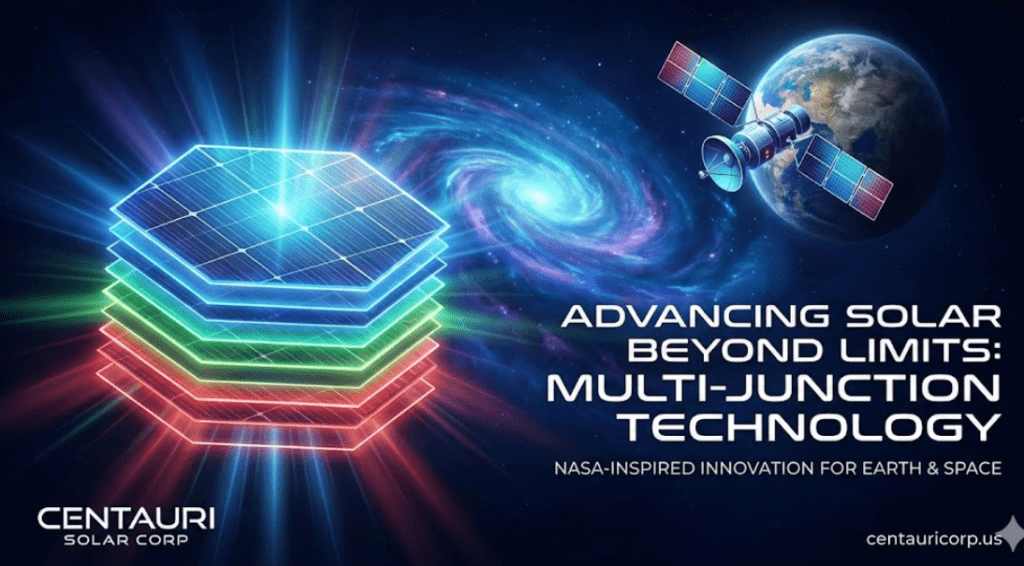
Solar power is at the forefront of innovation in a world that is rapidly moving to renewable energy sources and advanced space technologies. Centauri Solar Corp is a leading innovator in next-generation solar systems based on NASA technology. We are dedicated to developing solar technology beyond traditional solutions. The multi junction solar cells is a breakthrough technology that will redefine solar efficiency. In this article, we dive into what Multi Junction Solar Cells are, why they are a game-changer, and how Centauri is advancing this technology to power the future, on Earth and beyond.
Understanding Multi Junction Solar Cells
A Multi Junction Solar Cell is a type of advanced photovoltaic cell that layers different semiconductor materials – each with a differing energy bandgap – on top of one another. Multi-junction cells convert more energy from sunlight than conventional single-junction solar cells, which capture a limited portion of sunlight’s spectrum. Imagine it as a stacking of light absorbers that are tuned to different parts of the spectrum of sunlight. Together, they can capture energy much more efficiently and accurately than an individual silicon cell. The architectural innovation allows for conversion efficiency that is significantly higher than conventional solar technologies.
Its limit the maximum theoretical efficiency of single-junction cell to approximately 33.5% in standard conditions. Multi-junction cells, on the other hand, have reached efficiencies of over 40% when tested in lab settings. Advanced multi-junction devices can even reach of 47% with concentrated sunlight.
Multi-Junction Solar Cells: A Game-Changer
1. Solar Energy Conversion with Unmatched Efficiency
Multi-junction solar panels are able to convert more of the sun’s spectrum. Single-junction panels only have the ability to convert a small portion. The cells are more efficient because they convert more solar energy into electricity. This efficiency is not only beneficial for advanced applications, such as high-performance power systems or space missions. It is essential to maximize power output per area and weight.
2. Increased Power Density in Challenging Environments
Multi-junction solar cells are more efficient and can generate more electricity from a smaller surface. Their high power-to-weight ratio makes them ideal for places where space is limited, like satellites, spacecraft, or small solar panels on Earth. Centauri Renewable Corp. recognizes that power densities are especially important in space technology. Every gram and every square centimeter is crucial for mission success and operation efficiency. Our advanced solar technologies are designed to take advantage of the multi-junction cell’s best features for power systems that operate under extreme conditions.
3. High Performance in Space and Harsh Conditions
Multi-junction panels are the best choice for extreme environments, like outer space and high altitudes, due to their ability to withstand high temperatures and radiation. Multi-junction cells are the choice of photovoltaics for deep-space missions and satellites due to their durability and performance in a vacuum. These advanced cells are able to withstand high-energy photons from solar radiation without degrading rapidly. This is a major advantage for space exploration.
How do multi-junction solar cells work?
It is important to understand how these solar cells work in order to appreciate their efficiency.
Layered bandgap design
Solar cells with multiple junctions are made up of different semiconductor materials. Each material has a unique “bandgap”, a property that determines the wavelengths that can be absorbed.
- Top layer: Capture the high-energy photons (e.g., ultraviolet wavelengths).
- Middle layer: Absorbs midrange wavelengths such as visible light.
- Bottom layer: Converts infrared low-energy photons.
Multi-junction Cells can convert more of the light spectrum from the sun into electricity by stacking multiple layers of these tuned bands. Single-junction Cells are only able to use a single bandgap. Multi-junction solar panels are able to achieve higher solar conversion rates because of their efficient spectral capturing.
Multi-Junction Solar Cells in Real World Applications
- Space Exploration & Satellite Power Systems
Space power technology is based on multi-junction solar panels. These cells are perfect for powering:
- Satellites of communication
- Space Stations
- Deep-space probes
- Explore vehicles and Rovers
They are perfect for spacecraft power where every watt counts. Centauri Renewable Corp. is inspired by NASA solar innovations. We are working actively on application specific solar technologies to maximize the efficiency of multi-junction solar systems for space missions, and extraterrestrial applications.
- Concentrated Photovoltaic (CPV) Systems
Multi-junction solar cells are paired with concentrator systems for photovoltaics (CPVs).. These systems utilize mirrors or lenses that focus sunlight on a small area with high-efficiency multijunction cells to maximize power output. This is a particularly useful approach in areas with high levels of direct sunlight. CPVs are more expensive to manufacture than conventional solar panels. However, due to the efficiency of multi-junction technologies and specialized arrays they can be used for industrial-scale and utility-scale projects.
3, Emerging Terrestrial Solar Applications
Research and development are helping bring multi-junction technology closer to being affordable on the ground, despite it being more expensive than traditional silicon panels. Advanced fabrication techniques, material science innovations, and increased production are driving progress in expanding these high efficiency solar cells into mainstream large-scale and building-integrated Photovoltaics.
The Challenges and the Way Forward
Multi-junction Solar Cells face some challenges despite their excellent performance.
1. High manufacturing costs: Solar cells with multiple junctions cost more than silicon panels. This is because they have a more complicated design and use specialized materials such as gallium phosphide or gallium arsenide. These are harder and more expensive to manufacture.
2. Complex Production Techniques: For the fabrication of advanced products such as metalorganic Chemical Vapour Deposition (MOCVD) and, precision equipment and technical expertise are required.
3. Limitation of mass market availability: Multi-junction solar cells are more commonly used in specialized applications, such as space and CPV (concentrated photovoltaic) systems than in residential solar installations.
The U.S. Department of Energy and other institutions continue to fund research that aims at cost reductions as well as performance improvement. In the future, these efforts may make multi-junction cells more competitive on commercial solar markets.
Centauri Renewable Corp: Pioneering Next Generation Solar
Centauri Renewable Corp is at the forefront of solar innovation. Inspired by NASA technology and driven to meet the future’s needs, we have developed advanced Photovoltaic Systems based on principles similar multi-junction cell, designed for maximum performance, efficiency, and resilience. Our commitment to solving energy challenges on Earth and in deep space is reflected by our focus on the next-generation of solar technologies. Our research and development aims to develop solar solutions that are durable, efficient and transformative, from large-scale solar farms and space power arrays.
Multi Junction Solar Cell Technology is a significant leap forward in harnessing solar energy. It offers efficiency that exceeds conventional limits, and power-dense options ideal for advanced applications. They are currently used in specialized power systems and space applications, but ongoing technological advancements may soon expand their use to other renewable energy markets. The future of energy will be determined by multi-junction technology as demand for clean power continues to grow and the human race pushes further into space. Centauri has committed to exploring and applying these innovations to create a sustainable, energy-rich and future on Earth.